

In The News
California firefighters are speaking up about the issues that matter to our profession, our communities, and our future. From letters to the editor to published opinion pieces, these voices are helping set the record straight and bring the firefighter perspective to retirement security.
-
California firefighters understand better than most that pension policy has consequences. We also understand why Californians deserve a retirement system that is financially responsible, sustainable and fair to the people who serve them. That is why the debate over AB 1383 should be based on what the legislation actually does today — not on decisions made more than two decades ago.
AB 1383 does not return California to the pension system of the past. It builds on the safeguards established by the Public Employees' Pension Reform Act (PEPRA) enacted in 2013. According to CalPERS data, PEPRA has already saved cities and counties approximately $5.8 billion during its first 10 years and is projected to generate another $26.5 billion in savings over the next decade.
Those safeguards remain important. PEPRA’s requirement that employees pay half of the normal cost of their pensions remains intact. Firefighters will continue contributing at least half toward their retirement benefits. The projected increase in annual normal cost contributions under AB 1383 is approximately $282 million total for the over 2,900 agencies that contract with CalPERS, but that does not mean taxpayers are being handed a $282 million bill. Employees would be required to contribute approximately $141 million of that increase.
That distinction matters. Too often, the debate over AB 1383 suggests that firefighters are asking taxpayers to shoulder the entire cost of retirement benefits. That simply isn't the case. Firefighters are taxpayers, too, and we have every interest in maintaining a retirement system that is financially responsible and sustainable for the communities we call home.
Fiscal responsibility also means recognizing the realities of a career in the fire service. Firefighters face repeated exposure to carcinogens, traumatic incidents and intense physical demands that can take a cumulative toll over decades. A retirement system should recognize those realities while helping public safety agencies maintain an experienced and healthy workforce.
AB 1383 also does not simply hand firefighters a new benefit. Some provisions, including the reduction in retirement age and changes to the pensionable compensation cap, would take effect automatically and prospectively. Other changes, including a new retirement tier and movement between tiers, would remain subject to collective bargaining between employers and employees.
Collective bargaining is not a loophole or a backdoor process. It is the established way public employers and employee organizations negotiate compensation and retirement benefits. Those negotiations occur between the parties and are subject to the laws and processes governing public employment which also prohibits public safety members from striking.
California can learn from the pension challenges of the past without assuming every change to the current system repeats those mistakes. AB 1383 preserves PEPRA’s core safeguards while giving public safety agencies and their employees more flexibility to address the realities of a career in the fire service.
Protecting firefighters and protecting taxpayers are not competing goals. With AB 1383, California can do both.
Written by Darrell Roberts, President, California Professional Firefighters
Published in Napa Vally Register on August 20, 2026
Editor's note: California Assembly Bill 1383 (AB 1383) is a proposed legislative measure targeting public employee retirement benefits.
-
The recent commentary criticizing AB 1383 presents an incomplete and inaccurate picture of both the legislation and the realities of a career in the fire service.
Firefighters understand the importance of protecting taxpayers because we are taxpayers ourselves. We have every interest in ensuring California's retirement systems remain stable, sustainable, and responsibly managed.
That is why it is important to understand what AB 1383 actually does. The bill preserves PEPRA’s core protections while updating provisions that have created significant recruitment and retention challenges for public safety agencies across California.
The article suggests that taxpayers alone will bear the cost of these changes. That is false. AB 1383 leaves intact PEPRA's requirement that employees pay half of the normal cost of their pensions. Firefighters will continue contributing their share, just as they do today.
The article also ignores the realities of a profession in which occupational cancer, cumulative trauma, orthopedic injuries, and cardiac disease often shorten careers. Firefighters do not spend their careers sitting behind a desk. We carry people out of burning buildings, respond to medical emergencies, and are routinely exposed to hazards that can affect us long after the emergency has ended. Many firefighters do not retire early because they want to. They retire because years of service have taken a lasting physical and mental toll.
AB 1383 recognizes that reality. Some provisions, such as changes to retirement age and compensation limits, would take effect automatically, while others would remain subject to collective bargaining between employers and employees.
California's firefighters deserve a discussion based on facts, not fear or conjecture, and an acknowledgment that protecting those who protect the public is not incompatible with protecting taxpayers.
Written by CPF President Darrell Roberts
-
As a retired CAL FIRE firefighter and Chico resident, I believe AB 1383 represents a thoughtful, responsible step forward in supporting the long-term health and stability of California’s fire service.
Firefighting is a physically demanding career with well-documented risks, including higher rates of cancer, injury, and post-traumatic stress injury. AB 1383 addresses this by reducing the normal retirement age for firefighters to 55, rather than the current age of 57. Two years may seem short, but firefighting catches up with you, and the things I did at 35 were significantly more challenging at 50, never mind 57.
The bill also maintains the core safeguards established under pension reform in 2012. Every provision applies only to future service, with the benefits only accruing prospectively. There are no retroactive increases and no fiscal rollbacks that have delivered billions in savings.
AB 1383 also gives local governments flexibility. Cities and fire agencies can choose what works best for them through bargaining, rather than being locked into a system that doesn’t reflect local needs. That local control is essential to maintaining strong recruitment and retention, particularly as departments across the state face increasing demands.
At its core, this measure is about balance, protecting our pension system while ensuring it remains fair for the people who rely on it. Supporting firefighters in a meaningful, responsible way is not a step backward. It’s an investment in the safety and resilience of our communities.
Written by Mike Lopez, Chico resident and Secretary-Treasurer of the California Professional Firefighters
Published on July 30, 2026, in the Chico Enterprise Record: Letter to the Editor: AB 1383 is a responsible way to support firefighters – Chico Enterprise-Record
-
Firefighters begin their careers strong, energized and ready to serve. But after years of emergency calls, sleepless nights and repeated exposure to toxic environments, the long-term toll becomes undeniable. Recovery slows, injuries linger and the cumulative effects of the job don’t go away — they build over time.
Firefighters today have a higher call volume, face more hazards and work in environments filled with materials that produce toxic smoke and carcinogens than they did 15 years ago. In 2022, the World Health Organization’s International Agency for Research on Cancer classified firefighting as a Group 1 carcinogen, the most dangerous level of cancer risk.
For many firefighters, cancer isn’t a question of if — it’s when. Every additional year on the job means more cumulative exposures, and their impacts are well-documented.
However, crews who stand shoulder to shoulder on the same dangerous response to a fire or other natural disaster end up with vastly different retirements. For example, firefighters hired prior to 2013 often reach normal retirement age at 50, whereas those hired on or after January 1, 2013, have a normal retirement age of 57.
Now, Assembly Bill 1383, a proposal currently working through the California Legislature, closes that gap and brings fairness to the people who risk their lives for this state by making targeted adjustments to the retirement law that applies to all public employees hired on or after January 1, 2013. Authored by Tina McKinnor, D-Inglewood, the bill does so in a measured, responsible way by aligning retirement policy with the conditions firefighters face in the field.
Contrary to recent claims, AB 1383 does not undo the reforms established under the 2013 Public Employees’ Pension Reform Act (PEPRA). This bill makes forward-looking adjustments to reflect today’s realities in the fire service: no retroactive benefits, required cost-sharing and local control through collective bargaining.
Firefighters are already required by law to pay 50% of the contribution to the normal cost of their pensions. AB 1383 does not change that. Any adjustments made under the bill are prospective — shared investments between employees and employers, not unfunded mandates placed on taxpayers.
Additionally, AB 1383 allows firefighters to have a normal retirement age of 55 instead of 57. Two years may seem small on paper, but in practice they are not. Those are the years when injuries take longer to heal, and when the cumulative effects of toxic exposure become more serious.
This is not about whether a 56-year-old firefighter can still do the job — many can. The question is whether firefighters should have to remain in one of the most physically taxing professions longer than is safe.
When lives are on the line, and someone’s loved one is trapped in a burning building, communities depend on firefighters operating at their best. Experience matters, but the job’s physical toll is real.
AB 1383 allows firefighters to plan their futures, reduce prolonged exposures to hazards and leave the job healthier. It also helps fire departments manage long-term costs by reducing late-career work-related injuries, costly disability retirements and occupational illnesses.
The reforms enacted under PEPRA have already produced significant savings for employers — $5.8 billion in the first decade — with an additional $26.5 billion projected in the next. AB 1383 builds on that foundation.
This is not a return to past policies. It is a targeted adjustment that reflects current conditions and preserves fiscal discipline.
Doing nothing has consequences on firefighters who face significant dangers each shift: higher injury rates, increased job-related cancer claims, staffing shortages and the growing reliance on mandatory overtime when experienced yet injured firefighters can no longer report for their assigned shifts.
After decades of showing up for strangers on their worst days, AB 1383 offers something simple: the chance to step away while still healthy.
Written by Sacramento Area Firefighters, Local 522 Director Jeremy Gardella. Published on May 31, 2026, in the Sacramento Bee: Retirement age change proposal for California firefighters | Sacramento Bee
-
As union president of the Marin Professional Firefighters group, I am writing in response to a recently published letter that appeared to misrepresent Assembly Bill 1383 and those supporting it. To be clear, Assemblymember Damon Connolly is one of dozens of co-authors who support the bill. That distinction matters because some claims about the bill are inaccurate, and the reality seems to be far different from author Richard Tait’s perspective.
AB 1383 does not remove safeguards or undo reform under the Public Employees’ Pension Reform Act. Core protections remain in place, and there are no retroactive benefit increases. These changes apply only to future service.
Importantly, AB 1383 preserves local governance control. The opportunity to bargain for a new benefit must be negotiated for what works best locally.
PEPRA has already saved billions and will continue to do so. AB 1383 does not undo those savings; it adjusts them. It’s not a system overhaul; it’s a targeted update.
Taxpayers are not left covering unchecked costs. Employee and employer contributions remain part of the system, and the 50/50 cost sharing, as required by law, remains. It’s a shared responsibility.
Firefighters are now facing longer and more deadly wildfire seasons, higher call volumes, repeated exposure to toxic materials linked to cancer and significant instances of Post-Traumatic Stress Disorder. Allowing firefighters to retire at 55 years old instead of 57 is not excessive; it’s practical. Keeping firefighters on the job longer doesn’t reduce costs; it shifts costs into injuries, disability retirements and long-term health claims.
Suggestions that recruitment can be solved with bonuses or pay increases miss the point. Firefighters hired under PEPRA already receive reduced benefits compared to previous generations. This bill helps address that gap in a responsible way.
— John Bagala, San Rafael
Published in the Marin Independent Journal Readers’ Forum for May 31, 2026
Marin IJ Readers’ Forum for May 31, 2026 – Marin Independent Journal
-
OPINION – Firefighters face extreme risk on a daily basis, running into danger to protect our communities from fires, hazardous spills, natural disasters and medical emergencies.
For decades, firefighters could count on retiring at an age that reflected the dangers of the job. That’s no longer the case. This is an outcome that is becoming less attainable for the younger generations joining the fire service.
Younger firefighters now face longer careers, even as wildfires intensify in size and frequency, and the risks they take every day only increase. That’s why the fire service is united in our strong support for Assembly Bill 1383 (McKinnor), a bill that strengthens retirement security for firefighters by lowering the retirement age from 57 to 55.
AB 1383 makes targeted, narrow adjustments that recognize fiscal realities while working to protect retention, recruitment and the overall well-being of the fire service.
It is important to clarify that AB 1383 aligns our state retirement policy with federal IRS limits and protects local control established under PEPRA by making key provisions subject to local bargaining. Nothing in this measure is retroactive, and costs are shared between the employer and the employee.
AB 1383 is intentionally designed to be flexible, responsible and locally driven. The reality of the matter is that it makes two targeted and prospective adjustments and restores the ability for local governments and bargaining units to negotiate retirement terms.
This approach ensures that every community can make decisions based on its own resources and priorities, rather than being forced into a one-size-fits-all solution.
Lowering the retirement age is not about individual benefit; it is about protecting the health of all firefighters and ensuring their readiness when disaster strikes. We continue to learn more about how dangerous this profession really is, particularly when it comes to the deadly effects of cancer.
Every year cancer takes more of our members, colleagues, and friends – this last year alone over half of the line of duty deaths of firefighters in California were cancer-related. Every day spent on this job means more exposures to structure and vehicle fires, lithium-ion battery fires, full of deadly, potent carcinogens such as PFAS, asbestos, benzene, hydrogen fluoride and more.
Studies have repeatedly shown that firefighters suffer elevated rates of cancer and in 2022 the World Health Organization’s International Agency for Research on Cancer formally recognized the very profession of firefighting as a Group 1 known human carcinogen.
When retirement reforms were passed in 2012, they didn’t fully account for the long-term health risks firefighters face. This bill takes reasonable, measured steps to balance both the security of retirement funds and protect the health of the men and women who have stepped up to protect us all.
On April 24, 2025, more than 300 firefighters from every corner of California came together united in support of AB 1383 with one message: “Strengthening retirement security for firefighters is essential to our health and safety”.
That day it was clear; the support for AB 1383 is not limited by party lines. California legislators from both sides of the aisle recognize and support protecting those who protect us.
For my generation, our earned retirement acknowledged the sacrifices made in service to others. AB 1383 restores that fairness and ensures our communities are protected by a workforce that is healthy, prepared, and supported.
Brian K. Rice is president emeritus of California Professional Firefighters and a retired Sacramento Metropolitan Fire Department firefighter.
Published in Capitol Weekly on May 6, 2026: AB 1383 provides firefighters with a fair path to a safer retirement – Capitol Weekly | Capitol Weekly | Capitol Weekly: The Newspaper of California State Government and Politics.
-
I was disheartened with the Editorial Board’s suggestion that AB 1383 eliminates the reforms adopted in the Public Employees’ Pension Reform Act. Rather, AB 1383 is a measured adjustment to the retirement law that reflects the realities firefighters face each day. Whether responding to wildfire or a hazmat incident, California’s firefighters are facing heightened occurrences of injuries and illnesses, including cancer.
To meet this reality, AB 1383 would make targeted, prospective changes to the state’s retirement law. For public safety personnel, it would reduce the normal retirement age from 57 to 55, reducing exposures to dangers. Further, the measure would adjust the pensionable compensation cap to better align with our current cost-of-living realities. Finally, it would allow employees and employers to bargain over prospective increases in their pension formula, within the limits allowed by the law.
AB 1383 does not permit retroactive benefits; it protects both firefighters and taxpayers.
Written by CPF President Emeritus Brian K. Rice. Published on March 29, 2026, in the Daily Breeze: Letter: Firefighters union disheartened by opposition to pension bill – Daily Breeze
-
The bill would lower the state’s retirement age from 57 to 55, a move which proponents say will help agencies hire and retain first responders.
SACRAMENTO, Calif. — The pendulum of pension reform could be swinging toward more generous benefits over a decade after California overhauled its retirement system if lawmakers grant public safety unions’ wish to lower the age when police officers and firefighters can retire.
Earlier this session, the Assembly passed a bill that would enable unions to negotiate more generous retirement benefits for newly hired police officers and firefighters, and lower the retirement age from 57 to 55, which labor groups say will help California and local governments hire and retrain critical public safety employees.
“What it does is it right-sizes PEPRA,” said Brian Rice, the president of California Professional Firefighters, referring to the Public Employees’ Pension Reform Act, which increased retirement ages and decreased how much retirees can receive for those hired after 2013.
The fiscal impact of the legislation, authored by Assemblymember Tina McKinnor, D- Inglewood, would be felt acutely by California cities and counties, which are responsible for contributing to their employees’ pensions. Associations representing local governments have opposed the legislation from a fiscal perspective since it was first introduced last year.
McKinnor’s bill is the “most significant piece of pension legislation for California since PEPRA was signed into law,” said Eric Stern, the CEO of the Sacramento County Employees’ Retirement System.
“The changes that AB 1383 would put into place would easily result in tens of millions of dollars in annual costs to a local retirement system,” Stern said.
Legislative analysis of the bill, conducted after it was amended in January to reduce how much it would cost, found that the new retirement benefits would increase contribution costs by more than $370 million in the first year, if employers and unions agree to the new formulas.
In addition to allowing unions to push for lower retirement ages and better retirement benefits, Assembly Bill 1383 would also increase the compensation cap that retirees are eligible to make.
Under PEPRA, members of the California Public Employees’ Retirement System who participate in Social Security are eligible to receive up to $155,081 per year in retirement benefits. The new compensation cap would increase to $280,000, which is in line with the Internal Revenue Service cap.
Improved retirement benefits will attract top talent, supporters say
In a letter, signed by more than 75 unions, asking for a lawmaker’s support of the bill, Rice wrote that the longer firefighters are on the front lines, the more likely they will develop job-related illnesses, such as cancer, which could result in additional costs due to disability retirement or workers’ compensation.
“It’s a health and safety issue,” Rice said. He said reducing the retirement age to 55 will “cut down on some years of exposure” to toxic chemicals that firefighters encounter in the field.
The proposition would additionally help local police departments grow their ranks, said Brian Marvel , the president of the Peace Officers Research Association of California . The law enforcement group issued a brief last year that found California counties, on average, had less than two officers for every 1,000 people, which is lower than the national average.
“Law enforcement isn’t as attractive as it once used to be for a variety of reasons,” Marvel said. He pointed to how the national dialog around police has changed in the last 10–15 years and that has contributed to fewer people seeking jobs in law enforcement.
The proposal is designed to help ensure public safety careers remain competitive, McKinnor said.
The lawmaker acknowledged that the issue with hiring isn’t that there aren’t enough people applying to these positions, but rather that local police departments and fire agencies need to attract better candidates.
“If we want the best people to protect us in our communities, we need to make sure that the professions remain sustainable over the long term,” McKinnor said.
Cities and counties have cost concerns with PEPRA changes
After CalPERS’ fund’s assets decreased by over $70 billion in value due to the financial crisis of 2008, California struggled to keep up with the generous retirement benefits previously promised to public employees.
In response, former Gov. Jerry Brown spearheaded California’s pension reform in 2012 to help CalPERS achieve long-term stability. Last year, Brown said he was opposed to these changes to PEPRA.
Between 2012 and 2023, the first 11 years of PEPRA’s existence, the state, schools and public agencies saved $5.8 billion in savings due to PEPRA, CalPERS estimated in 2024. Over the subsequent 10 years, CalPERS expects to save $26.5 billion from the pension reform effort as the share of PEPRA members grows.
CalPERS is still not fully funded, the retirement system most recently reported that it has over 83% of the funds to cover its financial obligations.
The week before McKinnor’s bill passed through the Assembly Appropriations Committee this January, a coalition including the League of California Cities and the California State Association of Counties sent a plea to committee chair Assemblymember Buffy Wicks , D- Oakland , to oppose the legislation.
The groups noted that cities and counties have been approving salaries based on the assumption that benefit cost would remain consistent with PEPRA law. Opening the door to higher retirement benefit costs for employers would create financial strain on local agencies.
“By increasing the cost of these benefits, AB 1383 would result in less money for salary increases, which could therefore harm future recruitment efforts. Additionally, the changes in this bill could result in labor unrest by furthering the equity issues between safety and non-safety employees,” the coalition wrote in January.
In response to those concerns, McKinnor noted that her legislation does not retroactively change existing benefits — it would only apply to future hires.
Additionally, she said that the bill does not mandate employers offer these benefits to police officers and firefighters, rather it allows for local decision-making through negotiations
“Cities and counties can decide whether to adopt these formulas through collective bargaining, based on their fiscal situation,” she said.
The legislation comes at a time when county leaders are grappling with higher than expected costs.
A recent analysis by CSAC found that President Donald Trump’s One Big Beautiful Bill Act is expected to increase counties’ costs by $9.5 billion a year due to federal funding losses related to health care.
Published in the Sacramento Bee/Police1 on March 12, 2026.
Gilroy Firefighters Support AB 1383
Members of the Gilroy Fire Fighters Association Local 2805 joined firefighters from across California on June 25, 2026, to support AB 1383, a bill focused on protecting retirement security for firefighters. The group emphasized that strong retirement systems help recruit and retain career firefighters and ensure reliable public safety for the community.
As seen in Newsbreak, June 25, 2026
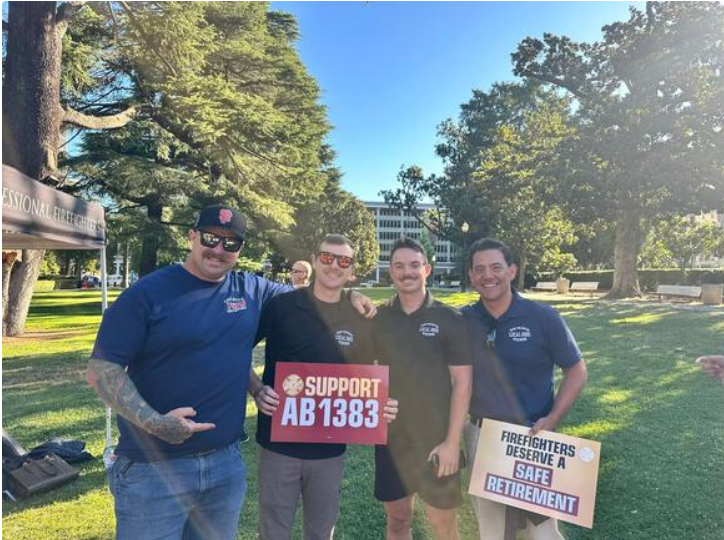
County Firefighters Advocate for AB 1383 in Sacramento
On June 24, 2026, members of Santa Clara County Firefighters Local 1165 joined firefighter representatives from across California in Sacramento to support AB 1383, a bill aimed at improving firefighter retirement security and helping recruit and keep career firefighters. The group met with legislators to discuss the importance of strong benefits and resources to maintain a stable public safety workforce.
As seen in Newsbreak, June 24, 2026

Alameda Firefighters Support Assembly Bill 1383
Members of Alameda City Firefighters L689 joined other California firefighters in supporting Assembly Bill 1383, which seeks to improve retirement benefits and lower the retirement age for public safety workers, including firefighters and police officers.
As seen in Newsbreak, June 24, 2026

AB 1383 RESOURCES

AB 1383 FACT SHEET

MEMBER STORIES

AB 1383 HANDOUT
